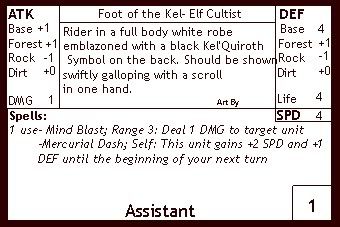
Tuesday, December 18, 2007

Unit of The Week: Sothkin Chemist


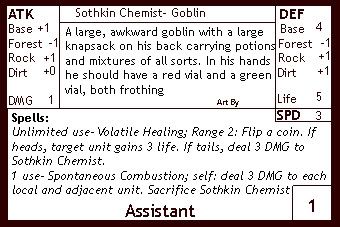
It's time again for everyone to drop what they're doing and listen to my insane rantings about army construction. To the left you can see the walking piece of awesome that is the Sothkin Chemist. I predict that when the open play testing starts in a week or two, this unit is going to be in many many dominant armies until people start adapting their strategies to avoid him self-destructing their army away. The unit was one I made when first experimenting with the goblins, trying to capture the flavor of a bumbling goblin that sometimes healed with his potions but quite often just blew himself up. It took Gavin only a short time to realize that this unit could be the key piece of an extremely dominant army that wins by trading 2 or 3 for one of your units for theirs. Tonight, I'm going to show you two armies, one of which is the army Gavin has designed and has done extremely well in internal testing, the other of which is the army that I have designed to make maximum use of the piece.

Army One: Gavin's "The Boom Deck"

Explorers: 3
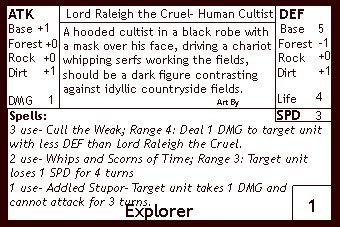
1x Lord Raleigh the Cruel- Provides Long-Range support with the unlimited range Addled Stupor and range 4 Cull the Weak
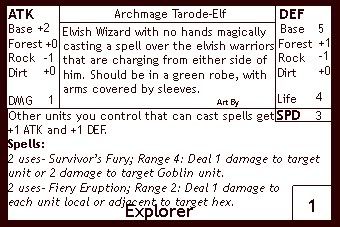
1x Archmage Tarode- Simply amazing, pumps up basically every unit in the deck, especially giving that crucial extra point of defense to the Sothkin Chemist
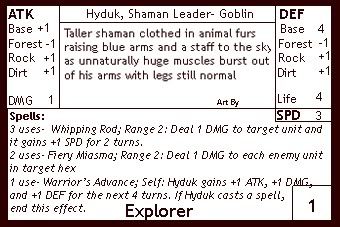
1x Hyduk, Shaman Leader- Whipping Rod can take out weakened enemy units or spur a last minute flag capture. Fiery Miasma is a great 1 hex spell that only affects enemies.

Assistants: 15
3x
Sothkin Chemist- Often taking out 2 or 3 enemy units, the Chemist is simply an all-star. Don't use it's healing ability much, as it only makes it an easier target for enemy magic-users
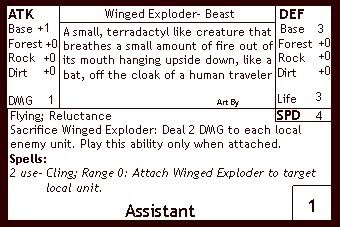
3x Winged Exploder- The next unit giving "The Boom Deck" its name can deal 2 damage to each local enemy unit when it attaches. this generally causes 2 units to each lose 2 life, which, combined with spell-casters, spells doom for most enemy assistants
3x Kaalik Acidspitter- The Kaalik Acidspitter, while somewhat of an odd choice for this army, is simply devastating on both offense and defense. Its acid ability combines well with Cull the Weak, and the 2 DMG ranged attack can destroy enemy assistants easily.
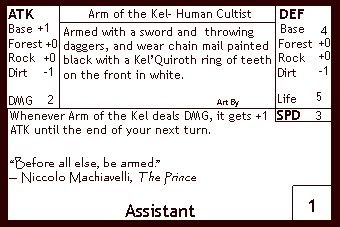
2x Arm of the Kel- The only real strong melee unit, the 5 life, 2 DMG Arm of the Kel packs a punch that can be used to tie down and eliminate enemy explorers with the help of Acidspitters and your spellcasters.
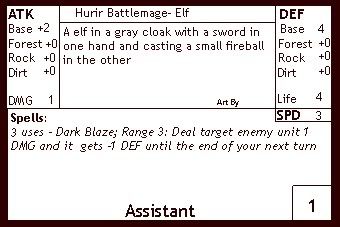
2x Hurir Battlemage- While a mediocre unit on melee attack and defense, the Dark Blaze spell shines when you need to rush a heavily fortified enemy.
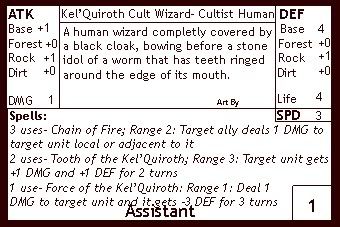
2x Kel'Quiroth Cult Wizard- We have already covered the interaction between the Cult Wizard and Arm of the Kel here, but it also provides a finisher with tooth of the Kel powering a +1 DMG offensive to a unit already hit with a -3 DEF penalty.

Artifacts: 3
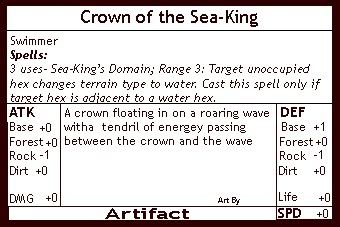
1x Crown of the Sea King- the Swimmer ability is highly useful when escaping
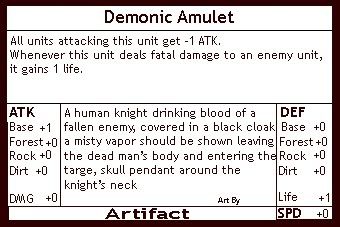
1x Demonic Amulet- gives +1 life for picking it up, with a useful ability
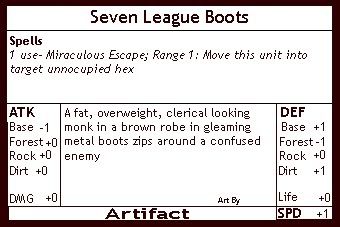
1x Seven League Boots- speed bonus makes for quicker retrieval

Terrain: 3
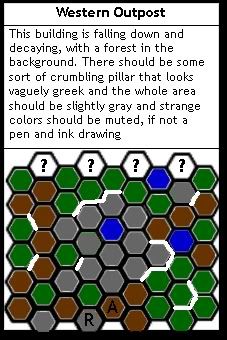
1x Western Outpost- Easily defensible, with great positions for casters to set up in
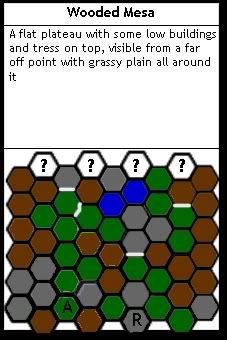
1x Wooded Mesa- Advantageous terrain for most of map
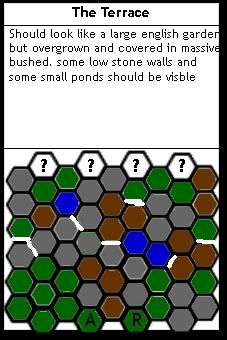
1x The Terrace- Choke points are ideal for blowing up chemists in

I am going to leave this space for a piece on how to play this army to be written later (perhaps by the army's creator, Gavin)

Army Two: John's "Two Birds, One Stone"

Explorers: 3
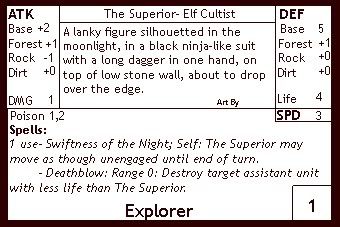
1x Archmage Tarode- Simply amazing, pumps up basically every unit in the deck, especially giving that crucial extra point of defense to the Sothkin Chemist
1x Tesl the Beckoner- Spawning Chemists in 1 turn range of enemy units makes me laugh. A LOT.
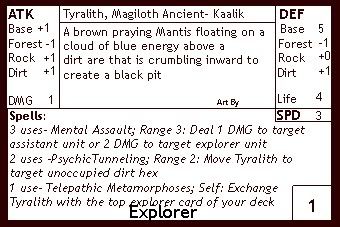
1x Tyralith, Magiloth Ancient- Tyralith is simply the best explorer to retrieve the artifact late in the game. Too early in the game for that? That's easy, just morph him into one of your other two explorers and save him for later.

Assistants: 15
3x
Sothkin Chemist- Often taking out 2 or 3 enemy units, the Chemist is simply an all-star. Don't use it's healing ability much, as it only makes it an easier target for enemy magic-users
3x Winged Exploder- This can deal 2 damage to each local enemy unit when it attaches. this generally causes 2 units to each lose 2 life, which, combined with spell-casters, spells doom for most enemy assistants
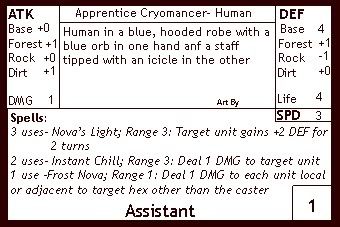
3x Apprentice Cryomancer- Nova's Light can protect your units while helping Cull the Weak, and Frost Nova is a great AOE spell.
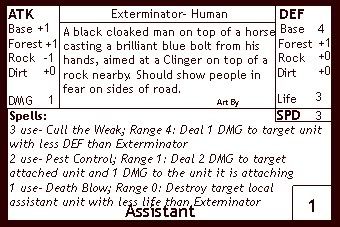
2x Exterminator- Cull the Weak provides long-range backup for your units, while deathblow helps finish of stragglers of attacks by Exploders and Chemists.
2x Kaalik Acidspitter- The Kaalik Acidspitter, while somewhat of an odd choice for this army, is simply devastating on both offense and defense. Its acid ability combines well with Cull the Weak, and the 2 DMG ranged attack can destroy enemy assistants easily.
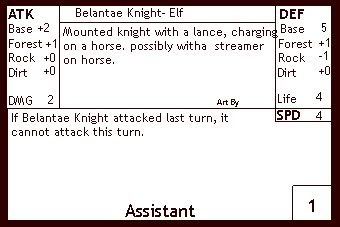
2x Belentae Knight- with 4 movement and 2 DMG, the drawback doesn't matter when you can move in and kill enemies quickly.

Artifacts: 3
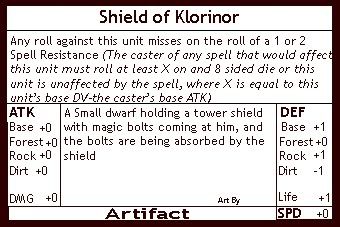
1x Shield of Klorinor- Spell Resistance is amazing
1x Demonic Amulet- Gives +1 life for picking it up, with a useful ability
1x Seven League Boots- Speed bonus makes for quicker retrieval

Terrain: 3
1x Western Outpost- Easily defensible, with great positions for casters to set up in
1x Barricades- A sort of cross between Outpost and Terrace, Barricades is defensible and has choke points for Chemist destruction.
1x The Terrace- Choke points are ideal for blowing up Chemists in.

Play Strategy:
Playing the "Two Birds, One Stone" army is really quite simple. Use your strong offensive casters in support positions while trading multiples of their units for single ones of yours. When they have a brief advantage, simply retreat back into your well-defended maps and start picking them off by spells (as spells can go through walls). When you have Tesl the Beckoner out, you can use this strategy on their side of the board, putting your a turn or two of movement away from their artifact space. When you have Archmage Tarode out, you can play a little more riskily, as you can hold your own in melee combat. The general way the deck wins is by just killing off all of the enemies or by using Tyralith to steal their artifact when you've put them at enough of a disadvantage.

Differences Between the Two:
The army that Gavin uses is much more offensive, with 3x Acidspitter and 2x Arm of the Kel. My army tries to play defensively, and as such has more casters, such as the Apprentice Cryomancer. His explorers are much more concerned with support roles, whereas I am using my explorers as the warriors that I don't include among my assistants (yes I am aware that Tesl has basically no attack, but he spawns my army forward) Anyway, as it is getting late, I will try to update these again soon, but now guarantees.

Friday, December 7, 2007

This Week In Ruin: December 7

Considering I haven't posted in over a month, let me bring you up to speed. Ruin development has bogged down as we lack fresh inspiration for new units. We have been playing a lot of games recently, so we made a lot of changes to individual units. Currently, we are working on rounding out our unit base and increasing our numbers of terrain and artifact cards. As our goal is begin official playtesting over winter break (Starting December 21st), we will be crunching in overtime over the next couple of weeks to make up for lost time in November.

Some Statistics: (Green for Good, red for bad)
Number of Assistants: 56
Number of Explorers: 15
Possible Combinations of 3 Assistants and 1 Explorer: 2634240
Number of Terrain Cards: 6

Number of Games of Ruin
Played to date: 30+
Average Game Time: 35-40 mins (goal time is 25-35)

You can see some differences in these versus our October 19th Statistics here
Though many things remain very similar, the number of games we've played (and therefore our experience of what makes a good unit on the battlefield) has gone up tenfold. Also, we're working on closing the gap with the final couple terrain, artifact, and explorer cards that we need to finish off the set.

Well, until next time, I hope I've Ruined your week.

Monday, October 29, 2007

Rules Schmules: Casting Spells

One of the most important things in Ruin is the spellcasting. Spells can be anything from a mental attack using carefully honed powers to conjuring a giant ball of fire.

They can be cast in many forms, but the way that they work in terms of game play is very specific. During the combat phase a unit with spells may instead of attacking, cast a spell. You must specify the target and the spell being cast at the beginning of the combat phase. The target unit must be in range of the spell at the beginning of the combat phase and must still be in range at the end of the attack step.

Spell templating on a card with be as follows:
-First, bold text will say Spells:
-Then, in italic text, the spells that unit can cast will be grouped by the number of uses they have. Some spells only have a few uses, some can be used an unlimited number of times.
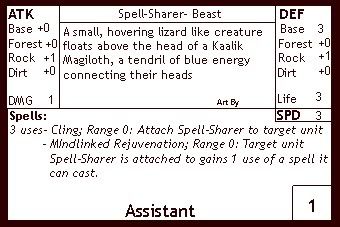
-Then, it will have a dash, list the name of the spell, a Semi colon, the range, then a colon, then the effect of the spell will be printed, so a spell section might look like this:

Spells:
3 Uses -Defensive Attunement; Range 2: Target ally gains "If this unit has a local or adjacent Kaalik ally, it gains +2 Armor" for 5 turns.
2 Uses -Mind Blast; Range 3: Deal 1 DMG to target unit
1 Use -Force of the Swarm; Range 2: Deal X DMG to target unit, where X is ½ the number of Kaalik units in play, rounded up

Spell effects are put on the stack at the end of the combat step, just after combat damage has been put on the stack, but before either player has a chance to play any instant speed abilities.
Many spells have a number of turns that they last. The number of turns a spell has left loses one at the end of your turn. So, for example, if you cast a spell that lasts for five turns, at the end of the turn you cast it on, it will have four turns left.

Terminology in spells:
Range: The maximum number of hexes away the target unit or hex can be. So for example, If a spell has range 1, you can target a unit in the hex of the caster or a unit adjacent to the caster, but not one two hexes away.
Target: this means that the spell will require you to select a target at the beginning of the combat phase
Unit: this means any unit within range of the spell. Alone, without any other specifications, it also means that they can target the caster of the spell if you so desire.
Hex: this means any hex within range of the spell (unless modified by local or adjacent)
Ally: this means a unit other than the caster that is controlled by you
Enemy: a unit in range controlled by your opponent
Hex: a single cell on the board
Local: in the same hex as the unit or hex referred (usually the caster)
Adjacent: in a hex next to the unit or hex referred to (usually the caster)

Thursday, October 25, 2007

Unit of the Week: Arm of the Kel


Today's blog is the test run of what we hope to make a weekly feature. Welcome to Unit of the Week. On the left you can see the stats for this week's unit, Arm of the Kel. It is the main infantry unit of the Cult of Kel'Quiroth, and serves as an easy way to get aggressive without drawbacks. Though it has above average life and damage, it has less than average base defense and terrain bonuses and only average base attack bonus. However, the thing that makes Arm of the Kel great is its ability in conjunction with other cult members.

This unit was concieved entirely position down, that is, I needed a main offensive unit for The Cult of Kel'Quiroth so I began his design as that. Originally, his ability triggered for extra damage to a local unit and he had a +2 ATK and 1 DMG. However, this proved to be too good with the ability of other units, so I changed it. originally his life and DEF were both 4, but I changed his life to five after realizing he would be functionally worse than Skeletal Halberdier.

Arm of the Kel is quite playable in many warbands/armies, so I am going to build one to show you some of his many talents.

One of the best parts of Arm of the Kel is his interaction with Kel'Quiroth Cult Wizard
This is going to form the basis of a Kel'Quiroth themed army with a well-rounded mix of units.
Explorers: 3
1x
The Superior- Can retrieve artifact in a pinch and takes care of tough spellcasters
1x
Lord Raleigh the Cruel- Prevents opponent starting too fast and dominating the game
1x
Archmage Tarode- Useful spells with an ability that makes your scouts and casters better

Assistants: 15
3x
Arm of the Kel - An obvious inclusion, and strong offensive line
3x
Kel'Quiroth Cult Wizard - defensive spells help, but Chain of Fire dominates the board
3x
Foot of the Kel - scout unit fast enough to get in, but can also use spell to pick of weaklings
3xExterminator - Works well against units that have been targets of Force of the Kel
3xSpell-Sharer- Adds amazing spell uses for caster explorers and adds uses of Force of the Kel

Artifacts: 3
1x
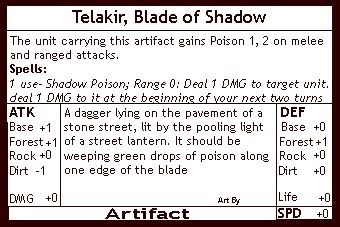
Telakir, Blade of Shadow- Allows you to fight your way out and even if they take it back it still poisons them
1xShield of Klorinor- this will allow units to survive longer once they pick up the artifact
1xDemonic Amulet- Unit survives longer and is less likely to get hit

Terrain: 3
1x
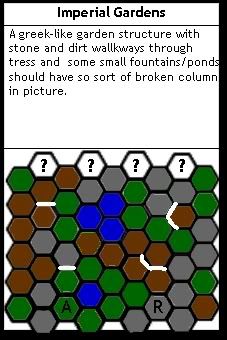
Imperial Gardens- Fast start map, lots of forest to position Exterminators on
1xThe Terrace- defensible with good terrain
1xWestern Outpost- incredibly easy to defend, position spellcasters behind choke points

Wednesday, October 24, 2007

How an Idea becomes a Unit

I will be filling in for Gavin's post this week, and when I asked him what he wanted to write the post about he said something strange about eating a peanut butter and jelly sandwich, which of course has nothing to do with Ruin so instead you will be getting something random from me. I thought maybe today we could talk about how a a bill becomes a law...I mean how a unit is made for the game of Ruin.

This process is rumored to start in Gavin's wandering mind in math class. After he scratches the idea for the unit down on lined paper (so primitive!) he will hand it to John some time later in the day and then John will reject it and so this would-be unit for Ruin dies.

But sometimes, if Gavin really likes the concept for a unit he will begin to debate with John and I on why it should be a unit in the exact form that he wrote it. This also too often fails but John (worn down by Gavin's persistent arguments and repeatings of "Come on!") will sometimes take the concept/stats for a unit and tweak them to be more usable by our game and no one turns out happy with this unit. Well thats not entirely true, John and I usually turn out happy and Gavin at least content that he made a unit.

This is the only filter that stands between the almost hundreds of units that Gavin pumps out every week and believe me while most of the time the filter will stop anything too powerful or (dare I say it) stupid from getting put into production, the system is not infallible. Then comes the part while we edit the unit or (if you prefer the term) neuter the unit which I (or Gavin if he gets his act together) will post about some other week.

For now, revel in the fact that you are only reading about Ruin, not designing or playing it.
Suckers...

-Vincent

Tuesday, October 23, 2007

A First-Timers Thoughts on Ruin.

Being the only person on the design team not to play Ruin, I was the butt of many a joke for some time but I finally grit my teeth and sat down (actually stood up) and played the game I had been helping design. I must start by saying that the game was fun and easy to understand even if it took some time to set up, especially since I had not created my team (army, war band) yet. I went for continuity of race and stuck with the humans. The war band was o.k. and could be successful and not successful as I was about to find out.

We flipped for terrain and I got lucky, flipping my favored map with plenty of forest which most of my army did well on. Also what I didn't know is that the lack of rock was also most excellent. Then was the building of the map which took some time. When we got started I took a defensive strategy (with a melee Explorer and caster assistants, I thought this might be a good idea) and let John's army cross sides first (which wasn't hard because he started out with mostly his scout units anyway). When combat did start I knocked out his assistants in usually one turn (because My explorer was slightly over-powered). Fighting continued in my favor until we had to leave for a party which we were already late for.

The next game I played was the day afterward, same armies, different terrain. My army did not do as well. The lack of forests meant I lost many units and often found myself overwhelmed by numerical advantage and "Polearm Formation". (a mechanic which increased his units with the ability when they were local or adjacent with each other)

This happened 2 times in a row and my conclusion is this: continuity in an army (not just in race) is important, an explorer that can stand up for itself in combat with assistants that support it is very effective, and terrain and numerical advantage can change the tide of battle.

Over all I enjoyed my first game(s) of Ruin and look forward to working on it more.

Monday, October 22, 2007

The New and Improved Combat System

Today I rewrote the combat system to make it a little simpler and take out some old rules that no longer applied. The actual system hasn't changed, just some of the wording. Anyway, here is the Ruin Combat System, in all it's dicey glory.

Combat System in Ruin
Units must be in the same square to do combat regularly. Some units may have abilities or spells that allow them to make attacks outside of their hex. The active player refers to the player who is doing the attacking. The Combat phase is divided as so:

1.) Beginning of Combat: The active player may play abilities, then the Non-Active Player. (at this time, spells being cast and targets of those spells are declared)
2.) Choose Cells For Combat: The Active player chooses cells in which combat will take place. He cannot choose a cell that is currently unoccupied. At this time, positional effects and terrain modifiers are calculated. They do not change until combat is over. After the Active player chooses which cells he will be attacking in, the active player may abilities, then the Non-Active Player.
3.)Attacks are Rolled Simultaneously in all cells: We recommend using different color dice to represent each cell’s combat. After seeing the rolls, the active player may play abilities, then the Non-Active Player. Once done, all modifiers are applied. Nothing beyond this point can change the Defense Value or attack roll. After all of the modifiers are factored in, if the Attack Roll equals or exceeds the DEF of the opposing miniature, damage is placed on the stack. (immediately after damage is placed on the stack, spell effects are placed on the stack. However, as damage is already on the stack, most spells effects can no longer affect combat at this point)
4.) Damage Step: with damage and spells on the stack , each player, starting with the active player, may play abilities.


The base dice system is an eight sided dice referred to as a d8. A standard roll is rolling 1D8. The goal here is to equal or exceed the opponents Defense value or DEF. The opponent’s miniature’s DEF is determined by three things.
1.) The DEF value printed on the card
2.) The Terrain Modifier
3.) Spells and Effects on the miniature (this includes abilities, Boost Cards and enchantments)

The Attack roll is modified by four things
1.) The attack modifier printed on the card
2.) The terrain modifier
3.)Numerical Advantage- If you have 2 units to an enemies one in a square, you have numerical advantage, meaning that you will get a +1 bonus on those units’ attacks. If you have 1 unit and your opponent has two, you get a -1 on your attack roll. For counting numerical advantage, count the swarm value of the unit, not just how many units there are. This forms the basis of the swarm rules.
4.) Spells and Effects on the miniature (this includes abilities and active artifacts)

Example:
Joey’s Ruminator is being attack by Matt’s Kaalik Hiveling on Dirt Terrain. First, We look at the Ruminator’s Defense Value and the Kaalik Hiveling‘s base attack modifier. Joey’s figure has a printed armor value of 6 and Matt‘s has a printed attack modifier of +1. Then, we look at the terrain modifier. The Kaalik Hiveling gets +1 to attack for being on Dirt, and the Ruminator gets +0 Armor for the terrain. Then, as the Kaalik Hiveling has a numerical advantage (swarm value of 2 vs the Ruminators swarm value of 1), they get +1 on the attack roll. So as it stands now (end of phase 2, before damage is rolled)

Joey’s Ruminator: 6 DEF

Matt’s Kaalik Swarm: +3 ATK

Dice are rolled, and Matt rolls a 4. That means that with the modifier, he can hit an DEF of 7. Damage moves onto the stack, neither player has anything more to play, and the Ruminator takes damage equal to the DMG amount printed on the Kaalik Hiveling card. Joey’s Ruminator has 4 life, and the Kaalik Hiveling dealt him 2 damage. If the Ruminator can be damaged with other effects, it can die this turn.


For reference, here are the units' cards:


Sunday, October 21, 2007

Story Outline: The World and Culture of Ruin

Two months ago, the lost continent Zantille rose from the sea in the middle of the ocean, and wondrous and strange things began to occur. People had visions of dungeons and crypts, and of massive palaces filled with people. Suddenly, in the dreams of a million ordinary people, a massive fireball shook their dream world, and they saw their metropolis sink into the sea. When the people awoke, most just laughed it off as a colorful dream. But some realized that it was a foretelling, and they left to seek the lost continent of Zantille. It was rumored that powerful artifacts were hidden in the ruined cities of Zantille, and rulers across all nations would kill to get them.

When advance scouts confirmed these rumors, the races of the world quickly sped to the New Continent. Humans, Elves, Dwarves, the hive insect Kaalik, the goblins, and many others were intrigued by the possibilities. Zantille could serve as a home for the Kaalik Hive, a treasure trove for the greedy goblins, and provide weapons of war for the ever-expanding humans. Not only did they find on Zantille amazing remnants of cites, ruined buildings and weapons and knowledge inside them, but also an unexpected group of inhabitants, the remains of the ancient Zantille, undead and reanimated by the own technology.

What length will the Explorers and their Assistants go to get what they desire? How far will the reanimated Zantillans go to protect what keeps them tethered to life, and to prevent others to suffering their same fate. Welcome, brave explorer, to the wide and unknown world of Ruin.

Saturday, October 20, 2007

The Cult of Kel'Quiroth and Other Happy Things

As promised, today's blog is detailing one of the new organizations in Ruin. I'm going to refer to them collectively as a "race" despite the fact that it is a composite organization of elves, humans, and many other species. The Cult of Kel'Quiroth is a semi-religious underground group that worships the Kel'Quiroth. The Kel'Quiroth are an ancient mythological beast in the world of Ruin, similar to our dragons (in their mythos, not in form or abilities). No one outside of the Cult truly believes that they are real.

The Symbol of The Kel'Quiroth

The Kel'Quiroth:
The Kel'Quiroth, commonly called the Kel, are an ancient race of burrowing wormlike creatures. Believed to have been as long as 200 meters, it is said that they could eat through solid stone. From what the cultist researchers have been able to figure out, the Kel had no faces, the front was just a giant hole ringed by teeth. The Kel have no brain, they have a central nervous system cord (think ganglia) that runs all the way through their bodies. They are, however, believed to have been greatly intelligent and capable of amazing destruction.

The Dogma and Structure of the Cult:
The main goal of the Cult of Kel'Quiroth is to perform "The Ritual of Awakening", a ceremony that they believe will reawaken the Kel'Quiroth, who the cult thinks will shower them with gifts and power. No-one actually knows what the ritual is, but The Cult is fervently researching it and trying to find out. Inside The Cult, structure is vary vague and tenuous, as it operates in small groups known
as circles. The leader of each circle is in two circles, one of his underlings, another with other leaders of circles of similar rank. The circles go all the way up to "The Grand Master" who's never been seen, only rumored and whispered about in fear. The cult operates mostly in secret on the mainland, but on Zantille may move freely as there are no repercussions from rulers.

The Ranks, in order from lowest to highest:

Lay Worshipper- These are civilians with no special skills. They occasionally provide services like blacksmithing and such to The Cult, but their primary function in the cult is to pay dues that go to support The Cult's research efforts.
Arm of the Kel- These generally lower circle soldiers serve as the main body of The Cult's armed forces. The are usually armed with a sword and occasionally throwing daggers, and wear chain mail painted black with a ring of teeth on the front in white.

Lay Wizard- Lower and Middle circle wizards provide magical support for The Cult. They inspire and intimidate those around them with their abilities and are known for being petty and spiteful. A large number of these came over to Zantille, as the blood of magic users is believed to be one of the many components of The Ritual of Awakening
Feet of the Kel- Middle circle messeng
ers, they are never allowed to see the contents of what they carry. They ride in a full body white robe emblazoned with a black Kel'Quiroth Symbol on the back. When in disguise, they generally wear brown cloaks, but in Zantille they operate in the open.
Hand of the Kel- These middle and upper middle circler combatants are the elite commandos of the Cult. There are skilled in both observation and elimination of threats. They often lead lower circles and command bands of Arms.

Eye of the Kel- The Eyes are Middle circle, but they never lead. The Eyes are almost always at the service of a powerful member of the upper circle. No-one but their controller and higher circles know which members of the cult are Eyes. The Eyes, in addition to spying on enemies and reporting their observations back to their controllers, also report infractions of other members that are against Cult code. They keep the cult in order, as no-one knows quite who might be an Eye.
Masters- The Masters lead upper circles and are supreme in their command of other Cultists. They are always masked and never let anyone but the Grand Master see their faces. They are responsible for finding out information on the Kel'Quiroth in the ruins of Zantille.

Superior- The Superior is the swift enforcer of justice among the upper ranks of the cult. He is the Grand Master's right-hand man and is the most skilled assassin in The Cult. He controls a good number of Eyes and receives all important information that comes into The Cult. It is rumored that he has seen the Grand Master's face. All that is known about The Superior is that he is an elf roughly 1000-1500 years old.
The Grand Master- No-one really knows much about the Grand Master, as he has never been seen undisguised by anyone except The Superior. He is a master of disguise, and frequently masquerades as a low-level Lay Wizard of Hand of Kel. His age is not known, and some even say that he was alive at the founding of the cult 6000 years ago, longer than the life span of even the healthiest elf.

The Cult In Zantille:

The Cult has gone to Zantille to explore the Ruin's there for more clues to beginning the Ritual of Awakening. Unbeknownst to anyone but The Superior, The Grand Master has disguised himself as an ordinary Master, and is personally leading a band into Zantille. He, in a vision, saw that there was a hibernating Kel'Quiroth underneath the continent of Zantille and is going to try to complete The Ritual there. He, however, is going to need several powerful artifacts and the final part of the Ritual to accomplish his goal.

Sample Cultists:
Here are a few sample Cult of Kel'Quiroth units. The first is a magical beast that the masters and eyes have tamed to deal with enemy Spellcasters. The second is a sample Lay Wizard.


Well, until next time, may you have happy dreams of murderous Kel'Quiroth cultists and their crazy plots.


Friday, October 19, 2007

This Week in Ruin

No, my week this week actually went quite nicely, and though I did do poorly on last week's Math quiz, this week's test seemed to be a small improvement (though practically anything can beat my atypical 20% score last week). Now that i have caught you up (sort of) to what the general format of Ruin is, let me give you some statistics about Ruin as it is so far. (green for good, red for bad)
3- # of games of Ruin that have been played to completion
3- # of people on the Ruin design team
40- the average # of minutes a game of ruin takes
53- # of assistants that are available to play with right now
12- # of explorers available right now
1786524- possible combination of 3 assistants and an Explorer (3 spots with 53 possibilities each and 1 with 12, so 53*53*53*12=1786524)

Wow. It was just like a little numerical Christmas.

This week in Ruin, a major development was made by Gavin. Gavin created a new mechanic that looks to be a focus of a large number of units inside the game. Gavin originally conceived of a unit he dubbed "The Clinger", a spider-like beast that attached onto its prey and slowly drained them of their life until its victim died or it was dislodged. However, under the current rules that we had, this kind of thing was incredibly hard to pull off, and would have never fit onto a single card. So we opened up an entire new space for design of units by creating the rules for attachment. We plan to have between 10-15 units that have the ability to attach onto other units. Some will be parasitic, some symbiotic, and others will just be piggybacking for a short while.

That generally sums up what happened this week in our development, as the attach mechanic was the most played around with thing in our designs this week. This weekend, I'll talk about our new kind of creature type (I'll give you hint it's not in Lord of the Rings, but is very heavy in H.P. Lovecraft) and what they bring to the table. If you are really interested in attaching rules, look below.

Photo Sharing and Video Hosting at Photobucket

The rules for attaching are as follows.


WARNING: THE FOLLOWING IS AN EXTREMELY TECHNICAL RULES DOCUMENT. IT IS NOT INTENDED FOR THE WEAK OF HEART. IF YOU HAVE A PRE-EXISTING CONDITION OR ARE A MEMBER OF THE GREEN PARTY, READ AHEAD AT YOUR OWN RISK!

Attaching
In Ruin, there are several cards that can Attach to, or “cling onto” other units. These units embody the idea of a small unit hanging onto a larger one. A unit can be attached to another unit, or attached by a unit. When the small unit is attached to the big one, the big one is not attached to the small one, it is considered attached by it. Though that may sound confusing, think of how a spider crawling on a car looks. The spider moves wherever the car moves, not the other way around.

Attached Dos and Don’ts: When a unit is attached to another unit, it may not move during the move phase, attack, cast spell or use abilities that do not expressly say, “You may play this ability (cast this spell) when attached to another unit” or “Play this ability (cast this spell) only when attached to another unit”. A unit attached to another unit may not be the target of attacks, spells, or abilities by the unit it is attached to. When you attack an enemy unit that you have an allied unit attached to, if you miss, but roll high enough to hit the DEF of the unit you have attached, deal the DMG to your unit.

Movement and Attached Units: A unit that is attached to another unit does not cause the unit attached by it to become engaged. A unit that is attached to another unit may not move on it’s own. However, when the unit attached by it moves, the attached unit moves as well. Any effect that would cause the attached unit or the unit attached by it to move causes them both to move. Ex: Gavin’s Clinger is attached to John’s Tyralith, Magiloth Ancient. John uses Tyralith’s Psychic Tunneling spell to move it to a dirt hex. The Clinger moves to that dirt hex as well, still attached.

Thursday, October 18, 2007

Catching Everyone Up

This blog is just to catch everyone up to where we are in Ruin development. I originally started this blog over on my x-fire blog. So anyway, here are some basics for you.

Yes. This game is very complicated, and I am aware that it is difficult to learn. It is really fun though, and when we start our open testing, drop me an email or a comment and I'll let you know where you can go to play it.

Our Design Team
:
Vincent- Vincent has been working on the Zantillan race and has designed a couple key rules. He hasn't yet had a chance to actually PLAY the game, but he's been busy recently.
Gavin- Gavin has been responsible for a large amount of the units and unit-based mechanics in the game. He brings a lot of great ideas to our team.
Me (John)- Ruin was my project baby for awhile, the idea I kicked around in my head but never had the guts to go through with. With some help from Vince and Gavin though, we finally have a semi-playable version that can be roughly tested and refined.

The Game:

Ruin is based off of the concept of two rival teams of explorers trying to explore an ancient ruin. On each side of the board, there is a powerful ancient artifact, which you try to take from your opponent by trickery or force. Ruin is set in a fantasy setting, which in addition to traditional fantasy themes (Elves and Goblins) introduces some new ones as well, such as the intelligent zombies known as the Zantillans. Ruin is played on a map made of up hexagonal tiles, on which players move around their units, attack, and cast spells.

This is one half of a Ruin map. The objects standing up represent walls and/or obstacles. Each player determines his half of the map off of a set of preset cards, shown below as well.
Half a Ruin Map


A terrain card
Anyway, units are divided into two main categories, Assistants and Explorers. Explorers are powerful, hard to destroy leaders and Assistants are...well...assisting them. A typical assistant card might look like this
Elvish Recruit Assistant
That may look a little daunting, but bear with me. (bare or bear, either way)

The column on the left with the heading ATK (attack) refers to the offensive capabilities of the unit in melee combat. The base ATK is modified depending on a number of factors, primarily your numerical advantage and what terrain you are on. The types of terrain correspond with the color of the hex. ie: Green is Forest, Gray/Blue is Rock, Brown is Dirt. The deep blue is water. The DMG is the amount of damage you deal on a successful attack, which requires you to roll an EIGHT-sided dice, add your total bonus, then equal or exceed their total defense.

The second column is DEF (defense). This represents how well the unit can defend itself against attack. The unit above is an Elf, so it is adept at defense in its forest homeland, but weak in the open area of Dirt terrain.

Between the two columns are listed the name and type of the unit, along with a box that provides a description of the drawing that should later appear in that box. The art description sets the tone and mood of the unit, and provides information of the appearance of it.

Directly below the art description box is the abilities box. Each unit in Ruin is unique, so you can combine and create teams of them that are different and adaptable. The abilities can range from anything as simple as the bow and arrow attack shown above to complicated magical spells that can steal opponents' abilities. The italic text in parentheses is called reminder text. On units with few, reminder text helps newer players understand and use those abilities better. On the center bottom of the abilities box is printed whether the unit is an explorer or an assistant.

Now we close in on the last of the unit explanation things for now. In the DEF column there are two spots marked Life and SPD. Life is how much damage a unit can take. A fragile mage can withstand little damage, whereas an undead warrior can take brutal amounts of punishment before succumbing. A unit dies when its life is equal to or less than 0. If the unit is an Explorer, damage clears at the end of the turn, giving them combat superiority over the smaller Assistants. SPD is the number of hexes a unit can move in a turn.

WOW. that was a lot of information for you to take in. Pause for a second. Take a breather. Perhaps listen to a soothing song or two. Now we continue.

Many people, well really just a couple, have asked why we're using 8sided dice for Ruin. The answer is actually pretty simple. A six sided dice has too little variety, as a single point of bonus on it would be much more powerful than on an 8sided dice. however, on dice above 8 sides, you have numbers that may get above 10, which is something casual players tend to avoid if they can.

Alright! The Final Thing for this Post.

Phases of the Turn:
A turn of Ruin is divided into several parts, or phases. Each of these phases is then divided into further parts, called steps. This is a breakdown of the steps and phases in a turn with a basic explanation of what happens in each step and phase.

Beginning Phase
-Beginning of turn step: this is when affects that trigger at the beginning of turn trigger. Abilities may be played here

-Reinforcement Step: IF you have less than 1 explorer and/or less than three assistants out, put the top cards of those decks into play on your spawn space until you have 3 assistants and 1 explorer. If your spawn space has reached the maximum unit limit (2 of your units), you may put your units into play on an adjacent unoccupied hex. If you have no cards left in both of those decks, and no units in play, you lose the game.
Abilities may be played here

Main Phase 1
-This is either a Move Phase or a Combat Phase
Main Phase 2
-This is either a Move Phase or a Combat Phase, whichever one Main Phase 1 wasn’t

End of Turn Phase
End of Turn Step: Effects that trigger at end of turn trigger here, and a spell that lasts X turns will lose one of those turns during this step.
Abilities may be played here
Damage Clear Step: Damage Clears off of Explorers during this step. Abilities cannot be played during this step

Main Phases Explained:
During the first main phase, you choose whether it will be a Combat Phase or a Move Phase. The second main phase will be whichever of these you did not choose for the first one.

Move Phase
Beginning of Movement Step: Boost effects can be played during this step
Move Step: You choose which unengaged creatures of yours will move up to their SPD in hexes. You cannot stop a unit in a hex with 2 allied units in it already, but you may pass through them. If those two allied units are engaged, you may not enter that hex. If at any time a unit becomes engaged while moving, that unit may not continue moving. You may not move onto the spawn space on your opponent’s side of the map, or the artifact space on your side of the map.
End of Move Step: Boost effects can be played during this step

Combat Phase
1.) Beginning of combat: At this time, spells being cast and targets of those spells are declared Boost effects can be played during this step
2.) Choose Cells For Combat: The Active player chooses cells in which combat will take place. At this time, positional effects and terrain modifiers are calculated. They do not change until combat is over. Boost effects can be played during this step
3.)Damage is Rolled Simultaneously in all cells: We recommend using different color dice to represent each cell’s combat. After seeing the rolls, the active player may play Boost Cards and Abilities, then the Non-Active Player. Once done, all modifiers are applied. Nothing beyond this point can change the Defense Value or attack roll. After all of the modifiers are factored in, if the Attack Roll equals or exceeds the DV of the opposing miniature, damage is placed on the stack. (immediately after damage is placed on the stack, spells effects are placed on the stack. However, as damage is already on the stack, most spells effects can no longer affect combat at this point)
4.) Damage Step: with damage on the stack , boost effects and abilities can be played during this step. After all effects have resolved, damage resolves.

Some Terms:
DEF: abbreviation for defense
ATK: abbreviation for attack
DMG:
abbreviation for damage
SPD:
abbreviation for speed
Assistant: The weaker units in Ruin, though there are 3 of them and only 1 Explorer
Explorer: The stronger, commanding units in Ruin, you can have 1 out at a time
Engaged: This unit is engaged in combat, meaning that it is in a hex with an enemy unit
Unengaged: This unit is not engaged in combat, meaning that it is not in a hex with an enemy unit
Hex: A single Hexagonal tile on the game board.